
Global Security Industry Trends in 2026: What China’s Market Is Telling Us
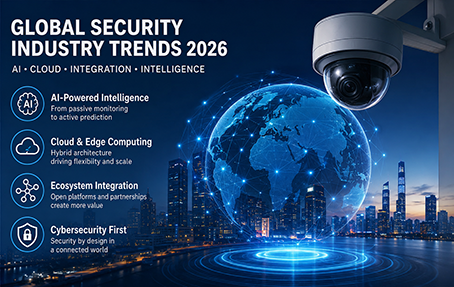
The security industry is changing.
And one interesting way to see where it is heading is to look at what is happening in China.
Recent first-half results from Chinese security companies show a mixed picture. Some companies connected to AI and key components are seeing strong demand, while traditional security equipment and downstream integration businesses are facing more pressure.
At first glance, this may look like a China-specific market situation.
It isn't.
The same changes are starting to appear across the global security industry: AI is becoming more important, security systems are becoming more connected, and customers are looking for complete solutions rather than individual devices.
Here are three trends we are watching closely in 2026.
1. AI Is Moving Beyond “Smart Features”
For years, AI in security cameras was mainly about features such as human detection, vehicle detection, face recognition and ANPR.
That is changing.
AI is gradually becoming part of the decision-making process.
Instead of simply recording what happened, security systems are increasingly expected to understand what is happening and help operators decide what to do next.
For example, an AI-enabled system can identify a person entering a restricted area, distinguish a vehicle from a person, trigger an alarm, and send the relevant information to the right platform.
The next step is even more interesting.
Generative AI and visual language models are making it possible to search video using more natural descriptions, investigate events faster, and connect information from different security devices.
This could significantly change how security operators work.
The camera is no longer just a device that captures video.
It is becoming an intelligence layer at the edge of the security system.
2. Security Business Is Moving from Hardware to Solutions
Another change is happening on the business side.
Customers are becoming less interested in simply buying cameras, NVRs or access-control devices.
They want to know:
Can the system solve my problem?
A warehouse may need to reduce unauthorized access.
A parking operator may want better vehicle management.
A retail business may want to understand customer flow.
A logistics company may need faster incident investigation.
The camera is still important, but it is only one part of the solution.
This is why the traditional relationship between manufacturers, distributors, system integrators and end users is changing.
Instead of focusing only on who sells the hardware, more companies are working together around the final customer outcome.
For manufacturers, this creates a clear challenge: product development can no longer be separated from the application scenario.
The ability to support integration, APIs, SDKs, customization and different software platforms is becoming increasingly important.
3. The Camera Is No Longer Working Alone
Security architecture is also changing.
Traditional surveillance systems were largely built around cameras, NVRs and local servers.
Today, the picture is much more complicated.
Cloud platforms, edge AI, mobile applications, VMS platforms and third-party software are becoming part of the same ecosystem.
This is where hybrid cloud is gaining attention.
Customers still want local control and reliable recording, but they also want the flexibility of cloud-based management and remote access.
At the same time, more processing is moving directly to the camera.
An AI camera can analyze video locally, generate metadata and send only the information that matters to the next system.
That can reduce server workload and improve response time.
So the question is gradually changing from:
“Which camera should we buy?”
to:
“Which security ecosystem should this camera work with?”
That is a much bigger change than it sounds.
What Does This Mean for the Global Market?
The global market is not growing evenly.
According to Novaira Insights, the video surveillance equipment market grew in 2025, with stronger growth outside China, particularly in North America.
At the same time, China is moving into a more mature stage of the market, where equipment upgrades and replacement demand are becoming increasingly important.
This creates different opportunities in different regions.
Some markets are still building new surveillance infrastructure.
Others are replacing older cameras with higher-resolution, AI-enabled and more integrated systems.
For manufacturers and distributors, understanding this difference is becoming just as important as understanding the product itself.
And Then There Is the Supply Chain
There is another issue that cannot be ignored in 2026: component costs.
AI data centers are consuming huge amounts of memory and other critical components. This is putting additional pressure on parts that are also used in security equipment, including DRAM, NAND flash and storage products.
The result is familiar to anyone working in hardware:
higher costs, longer lead times and more pressure on margins.
This is one reason why security equipment prices are facing upward pressure even when shipment growth is not particularly strong.
For the industry, supply-chain management is becoming part of competitiveness.
Cybersecurity Is Becoming a Basic Requirement
As more security systems move onto IP networks and connect to cloud platforms, cybersecurity is becoming increasingly important.
A camera is no longer an isolated device.
It may connect to an NVR, VMS, cloud platform, mobile application or third-party system.
Every additional connection creates another point that needs to be managed.
At the same time, companies are starting to pay more attention to how AI itself is being used inside their organizations.
The rise of unauthorized or uncontrolled AI tools — often referred to as “Shadow AI” — is creating new governance challenges.
For security companies, this means AI development cannot focus only on accuracy and features.
Security, data protection, software updates and system management all need to be part of the conversation.
So, Where Is the Security Industry Heading?
Looking at these changes together, one thing becomes clear.
The security industry is moving away from a simple hardware competition.
Resolution still matters.
Lens selection still matters.
Night vision still matters.
But these are no longer the whole story.
The next stage of competition will be about how well a product fits into a larger system.
AI capability.
Open integration.
Edge computing.
Cloud and hybrid architecture.
Cybersecurity.
Customization.
Long-term service.
These are becoming increasingly important when customers evaluate security solutions.
For us as a security camera manufacturer, this is also changing the way we think about product development.
A good camera should not only capture a clear image.
It should be able to understand more, connect more easily, and create more value for the system around it.
That is probably the biggest shift we are seeing in the industry in 2026.
The future of security is not simply about seeing more.
It is about understanding more and doing more with what we see.
Sources & Industry References
This article is based on industry observations and reports published in 2026, including analysis from CPSE Expo, Security Industry Association (SIA), Axis Communications, Novaira Insights, Securitas Technology, Honeywell, and other security-industry sources.
Industry data and market figures are presented for informational purposes and may vary by research methodology and reporting period.
